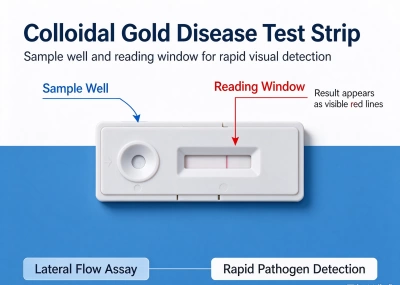
Disease Test Strips: How Colloidal Gold Technology Translates Pathogen Detection into a Visual Line
A disease test strip is, at its core, a lateral flow immunoassay that converts an invisible pathogen antigen into a visible colored line. In the sandwich format used for most infectious disease strips, an antibody conjugated to gold nanoparticles binds the target antigen in the sample; the complex migrates along the nitrocellulose membrane and is captured by a second antibody immobilized at the test line. Accumulated gold particles produce a red line when the antigen concentration exceeds the detection threshold.

This design delivers results in 10–15 minutes without instrumentation, which is why colloidal gold strips became the default home-testing format during the COVID-19 pandemic. However, the same simplicity imposes limits. Colloidal gold visual reading is qualitative or at best semi-quantitative, and sensitivity is generally lower than nucleic acid amplification methods. For respiratory viruses such as SARS-CoV-2, influenza A, and influenza B—which present with overlapping symptoms and frequently co-infect—a negative strip result does not exclude infection, particularly in the early viral shedding phase.
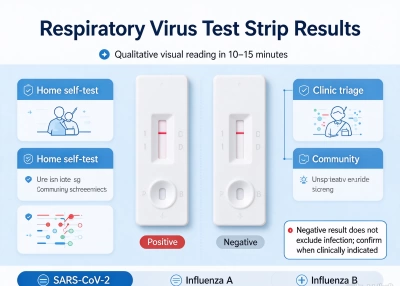
MeiBao’s disease test strip production follows the same colloidal gold platform used across its rapid test lines. For OEM partners, the practical question is not whether strips can detect a pathogen, but whether the chosen antibody pair delivers the clinical sensitivity required for the intended use setting—home self-test, clinic triage, or community screening.